
The Business of Hair
Advice to Brand-New Barbers and Hairstylists
Practical guidance for your first clients, your first workplace, and the habits that support a lasting career.
October 17, 2026
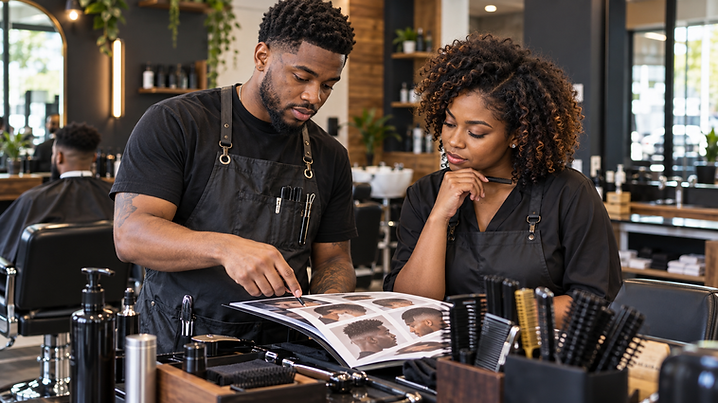
Practical guidance for your first clients, your first workplace, and the habits that support a lasting career.
Research checked October 17, 2026. Written for U.S. professionals; licensing and workplace requirements vary by state.
The first time a paying client sits in your chair, the room can feel different.
In school, someone was nearby to check your sectioning or help you work through a mistake. Now a client is showing you a picture, your next appointment is on the schedule, and you are trying to look as calm as you hope to feel.
You do not need to know everything on your first day. You do need to recognize what you can handle, ask for help early, and give people an honest understanding of what you are offering.
If you are looking for advice for new barbers or hairstylists, start there. A career behind the chair develops through repeated decisions: how you prepare, what you promise, how you listen, and what you do when a service becomes more complicated than expected.
1. Know what your license allows before building your menu
A school certificate, an individual license, and permission to operate a shop are different things.
The Bureau of Labor Statistics reports that all states require barbers, hairstylists, and cosmetologists to be licensed. The route and permitted services depend on the state and license category.
Before advertising services, check your licensing board’s current requirements for your credential, supervision, workplace, renewals, and scope of practice. Do the same before offering home visits, mobile services, or services from a home studio.
North Carolina offers a useful example. Its cosmetic art board has a separate salon licensing process, while the Board of Barber and Electrolysis Examiners has its own barbershop licensing process. An individual credential does not replace the establishment approval that applies to the business.
Check the actual requirements before paying for a space or announcing an opening. A social media account describing someone else’s setup cannot establish whether yours is permitted.
2. Choose a first workplace where someone will teach you
A beautiful station is appealing. So is a shop with a busy social feed. Look closely at what happens between appointments.
Are tools processed properly? Do people explain their decisions? Can a beginner ask for help without being embarrassed? Is there someone available when a consultation becomes difficult?
Ask the owner:
- Who will review my work while I am developing?
- How are new clients assigned?
- What happens if a service runs over?
- Who handles complaints and correction requests?
- What tools, products, and training are included?
- How does pay work, and what expenses would I cover?
Get the working arrangement in writing and read it before agreeing.
For federal employment taxes, the IRS looks at the actual working relationship, including behavioral control, financial control, and the parties’ relationship. A contract calling you an independent contractor does not settle the question by itself. Employment-law tests can differ, so clarify the arrangement rather than relying on the label “booth renter.”
3. Make infection control part of the appointment time
A finished haircut does not mean you are ready for the next client.
Your schedule needs room for hand hygiene, appropriate cleaning and disinfection, fresh supplies, and resetting the station. Build that time into the booking.
Read the disinfectant label. EPA guidance explains that the directions specify where a product can be used, how to apply it, and its required contact time. The surface must remain visibly wet for that contact time. A quick spray followed immediately by wiping may not meet those directions.
Follow your board’s rules and the equipment manufacturer’s instructions, including which items can be immersed. Keep clean tools separate from used ones, and discard single-use items as required.
For example, North Carolina’s cosmetic art board specifically addresses handwashing between services, separating disinfected tools from contaminated items, and cleaning and disinfecting clippers.
Know the workplace procedure for a cut or blood exposure before an incident happens. Keep the necessary supplies available and ask your supervisor to walk you through the procedure.
4. Build a small menu you can perform reliably
You may eventually specialize in advanced color, intricate designs, textured cuts, extensions, or detailed beard work. Your opening menu should reflect your current training and competence.
Begin with services you can assess, explain, carry out, and finish consistently. Expand as your skills develop.
For a new barber, that may mean concentrating practice on sectioning, shape, transitions, outlines, and working with different growth patterns. For a new hairstylist, it may mean strengthening foundational cuts, tension control, finishing, and the product systems covered in training.
Keep a practice record. Instead of writing “work on fades,” write “preserve the upper-side shape while connecting the blend.” Instead of “improve blowouts,” identify the section, brush control, or finish you want to improve.
Give yourself a specific skill to review with an educator or mentor.
5. Never let a chemical service become a guessing exercise
A client’s confidence that a service will be fine does not replace your assessment.
Before a chemical service, review relevant previous treatments, product history, reactions, current condition, and the manufacturer’s directions. Ask for qualified help when the history is unclear or the request exceeds your training.
FDA guidance recommends following hair-dye instructions and performing the recommended skin allergy test before every use. It also cautions that a reaction can occur despite a negative test. A strand test serves a different purpose: it can help assess the hair’s response, but it does not replace an allergy test.
For smoothing services, learn the product’s hazards before adding it to your menu. OSHA warns that some products can contain or release formaldehyde, including products described as “formaldehyde-free.” Review the safety data sheet, required controls, and employer procedures with someone qualified.
A useful sentence to practice is:
“I want to assess this properly before I promise that result. Let’s have my senior stylist review the plan with us.”
6. Learn to consult without making the client feel tested
Clients should not need professional vocabulary to receive the haircut or style they want.
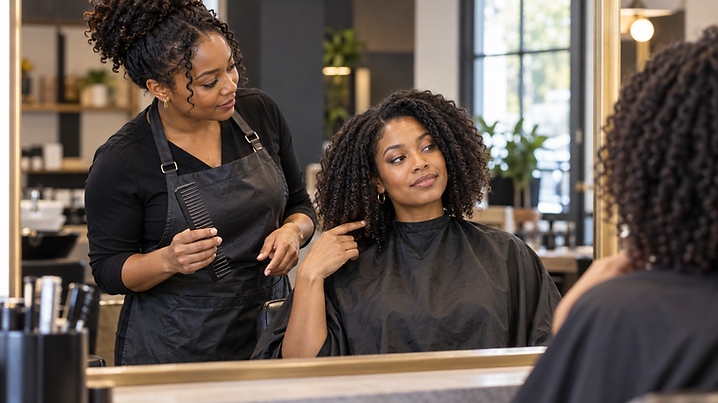
Ask what they like, what bothers them, how they usually wear their hair, and how much maintenance they want. Use the reference photo to discuss specific features.
“What do you like about this picture?” often tells you more than “Do you want it exactly like this?”
Before starting, summarize the agreed length, shape, service, price, and realistic upkeep. If something changes the plan during the appointment, explain it before proceeding.
Be equally honest about your experience. You can say that you are newly licensed and working with support. Avoid presenting yourself as an expert in a service you are still learning.

7. Measure your service time before promising speed
Online videos compress appointments into seconds. Your calendar cannot.
Track the whole appointment: consultation, preparation, service, finishing, checkout, and reset. Notice which stages take longer than you expected.
If a service regularly needs more time than you have allocated, adjust the booking or discuss scheduling with your manager. Booking every available minute leaves no space to handle an unexpected consultation or request for help.
When you run behind, tell the next client promptly and give a realistic update.
Speed should develop alongside accuracy. During practice, identify repeated work that comes from losing your guide, changing the plan, or skipping preparation. Those are useful places to improve efficiency without rushing the person in the chair.
8. Understand what you keep from each service
The amount a client pays is not automatically your personal income.
Depending on the arrangement, that payment may need to cover a commission split, rent, supplies, processing fees, insurance, software, laundry, taxes, and other expenses.
Here is an illustrative example for a self-employed professional:
A service brings in $50. Supplies and payment fees total $8. That leaves $42 before allocated overhead, taxes, and paying yourself. If the service and reset take 90 minutes, that is $28 per hour before those remaining costs.
Those are example figures, not an industry earnings estimate.
Record your own costs and timing. If you offer introductory pricing, define when it ends and what the regular price will be. Avoid setting prices solely by copying someone with different expenses, experience, or service times.
9. Keep records from the first payment—including tips
Record service income, tips, refunds, and business expenses consistently. Save supporting receipts and reconcile your records with payment-platform deposits.
If you are self-employed, use current IRS guidance to determine your income-tax, self-employment-tax, and estimated-payment obligations. Ask a tax professional to help you establish an appropriate system.
There is a current detail worth getting right: the federal qualified tips deduction does not eliminate reporting responsibilities.
IRS guidance provides for a deduction for eligible qualified tips for tax years 2025 through 2028, subject to conditions and limits. Barbers, hairdressers, hairstylists, and cosmetologists appear on the eligible occupation list. Self-employed tips remain business income, and self-employment tax can still apply.
Keep accurate records even if you expect to qualify. Eligibility for a deduction and the obligation to record income are separate questions.
10. Build a portfolio that tells the truth
You do not need a huge gallery to begin. You need clear examples of your actual work.
Ask permission before photographing or publishing a client. Photograph the result from useful angles with consistent lighting, and avoid edits that change the apparent density, hairline, color, or finish.
Explain what the viewer is seeing. “Low fade with fullness retained through the upper sides” helps a potential client understand the service.
Credit collaborative work accurately. If an educator guided or corrected the service, represent your role honestly.
Your professional profile should make it easy to understand your location, services, availability, and booking process. Build recognition around work you can repeat, rather than one photograph you cannot confidently recreate.
11. Give people a reason to return
Before the client leaves, ask whether anything needs adjusting while you can still assess it together.
Explain the home routine you recommend, then check that it fits their time, tools, and budget. If the style requires drying in a particular direction, demonstrate it.
Offer rebooking around their preferences:
“If you want to keep this finish, we can discuss a maintenance visit. Would you like to book ahead or contact me when you’re ready?”
When you receive feedback, listen before explaining. Keep conversations private and follow the business’s correction policy. Ask a senior professional to assess a problem you cannot confidently resolve.
A complaint can show you where the consultation, technique, or expectations need attention. Take the lesson seriously without turning one difficult appointment into a judgment about your entire future.
12. Pay attention to how you work physically
BLS identifies prolonged standing as part of the job. Consider your working position from the beginning.
Adjust the chair when possible, move around the client instead of repeatedly reaching, and ask an educator to review your grip and posture. Choose equipment you can control comfortably.
Protect time to eat, drink water, and reset between appointments. Discuss persistent discomfort with an appropriate healthcare professional rather than simply working through it.
Learning to deliver a service includes learning how to perform it throughout a working day.
A practical plan for your first 90 days
Treat this as a suggested learning schedule, not a deadline for becoming fully booked.
| Period | Focus | Useful actions |
|---|---|---|
| Days 1–30 | Establish dependable routines | Verify licensing and work arrangements; learn workplace procedures; time services; identify a mentor; practice a limited menu. |
| Days 31–60 | Improve repeatability | Review completed work; practice specific weaknesses; collect client feedback; build a small portfolio with permission. |
| Days 61–90 | Review what is working | Compare timing and costs; assess return visits; adjust booking lengths; choose your next training goal. |
At the end of each week, answer three questions: What improved? What still needed help? What will I practice next?
You can be proud of becoming licensed and still have plenty to learn. Both are true.
Arrive prepared. Keep the station ready. Listen carefully. Ask for help before uncertainty becomes a mistake. Those habits give your technique somewhere solid to grow—and give clients a reason to trust you while it does.
Starting your career behind the chair? Explore BarberScope and build a professional presence that shows your work, services, and approach to client care.